
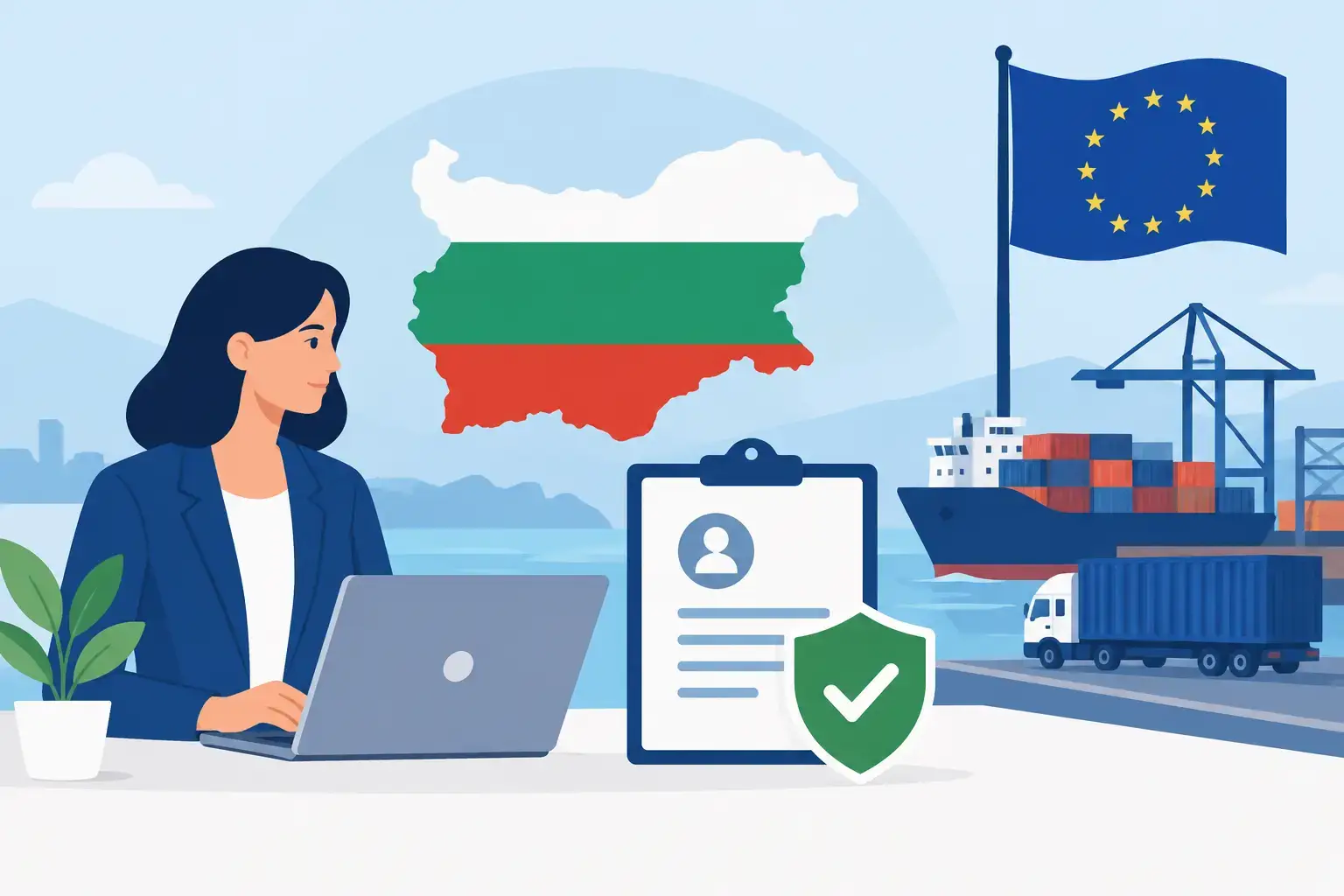
A Bulgarian company can be incorporated, VAT registered and fully operational without an EORI number – until goods cross an external EU customs border. The question of when Bulgarian EORI registration is required therefore depends less on the company’s age or turnover and more on its precise role in an import, export or customs procedure.
For overseas business owners, this distinction matters. Goods delayed at the border can mean missed delivery dates, storage charges and uncertainty over who is entitled to make the customs declaration. An EORI number should be arranged before the first relevant shipment, not when the lorry has already reached the customs office.
What a Bulgarian EORI number does
EORI means Economic Operators Registration and Identification. It is the identification number used by customs authorities across the EU to identify businesses and, in some cases, individuals involved in customs activity.
A Bulgarian EORI number is issued by the Bulgarian Customs Agency. In most business cases, it is linked to the legal entity or sole trader that is responsible for the customs activity. The number is recognised throughout the EU customs territory, so a Bulgarian company does not normally need a separate EORI registration in every Member State where its goods enter or leave the Union.
EORI is not a trading licence and it does not replace product-specific permissions. A business importing food, medicines, excise goods, chemicals or controlled products may still require additional registrations, certificates or inspections. It is simply the core customs identifier that allows the operator to appear correctly in customs declarations and related systems.
When is Bulgarian EORI registration required?
Bulgarian EORI registration is generally required where a Bulgarian-established company or individual acts in a customs capacity involving goods moving between the EU and a non-EU country. The most common trigger is importing goods into Bulgaria or another EU Member State from outside the EU.
It is also normally required when exporting goods from Bulgaria to the United Kingdom, Switzerland, the United States, Turkey or any other non-EU destination. The exporter or declarant must be identifiable to customs, even where a freight forwarder or customs agent prepares the paperwork.
The requirement can also arise for transit procedures, customs warehousing, temporary admission, inward processing, outward processing and other special customs procedures. These arrangements can be commercially useful, particularly for businesses moving goods through Bulgaria, but they require careful allocation of customs responsibility. An EORI number is often one of the first practical requirements.
A business should also expect to need EORI details when lodging or being named in safety and security declarations, applying for customs decisions, or dealing directly with customs authorities in connection with international goods movements.
Importing goods from outside the EU
If a Bulgarian company buys stock from China, the UK, Turkey or another non-EU supplier and imports it into the EU, it will usually need an EORI number. This remains true whether the goods arrive through a Bulgarian port, Sofia Airport, a road border point or an entry point in another Member State.
The commercial terms matter. Under some arrangements, the overseas seller may act as importer of record. Under others, the Bulgarian buyer is the importer and bears responsibility for customs duty, import VAT and declaration data. The contract, Incoterms and actual customs declaration should tell the same story. A vague agreement with a supplier or freight agent is not sufficient protection if the importer is later found liable for duties or penalties.
Exporting goods outside the EU
A company selling Bulgarian-made goods to a customer in the UK will normally need an EORI number for the export declaration. The same applies to a Bulgarian wholesaler sending stock to a non-EU market, even where the transport company handles the movement.
Exporting may support zero-rated VAT treatment, but only if the legal and evidential conditions are met. An EORI number does not, by itself, prove that goods have left the EU. Businesses should retain the appropriate export and transport evidence, and make sure their invoices, contracts and customs data identify the correct parties.
Using a customs representative
Many companies appoint a customs representative to submit declarations. This is sensible where a business has occasional shipments or lacks internal customs expertise. It does not automatically mean that the trader can operate without its own EORI number.
The position depends on whether the representative acts directly or indirectly and who is named as declarant, importer or exporter. A direct representative generally acts in the name and on behalf of the trader. An indirect representative may act in its own name but on behalf of another person, which can alter liability exposure. The appointment should be documented clearly before goods are shipped.
Situations where EORI is usually not needed
A Bulgarian company selling services to foreign clients does not need EORI merely because its customer is outside Bulgaria or outside the EU. Consultancy, software development, legal services and many other service transactions are governed by VAT and contractual rules rather than customs formalities.
Likewise, the ordinary movement of Union goods between Bulgaria and another EU Member State does not usually require an EORI number. A Bulgarian company selling goods to Germany, France or Greece is making an intra-EU transaction, not an import or export for customs purposes. VAT registration, VAT reporting, Intrastat obligations and proof of transport may still be relevant, but those are separate compliance questions.
There are exceptions. Goods may lose Union status, be moved under a special procedure, or travel through a territory with particular customs treatment. Businesses dealing with complex supply chains should not assume that an EU delivery is automatically outside customs control.
EORI registration and VAT registration are separate
One of the most frequent misunderstandings is that a Bulgarian VAT number doubles as an EORI number. It does not. The two registrations serve different authorities and different purposes.
VAT registration concerns the taxation of supplies, invoicing, reporting and recovery of input VAT. EORI concerns identification in customs procedures. A company may need both, only one, or neither, depending on its activity.
For example, a Bulgarian consultancy with EU clients may require VAT analysis but have no EORI requirement. A non-VAT-registered Bulgarian business importing machinery for its own use may still need EORI. A VAT-registered company that begins importing stock must assess EORI registration before the first customs declaration.
Import VAT adds another layer. The person named as importer needs to understand whether import VAT will be paid at the border, accounted for through a permitted mechanism, or potentially recovered through the business’s VAT position. This should be reviewed alongside the commercial terms of the purchase rather than treated as an afterthought.
Which country should issue the EORI number?
A company established in Bulgaria will normally obtain its EORI number from the Bulgarian Customs Agency. Once issued, that number can be used for customs purposes across the EU.
The position is more nuanced for a business established outside the EU. In many cases, a non-EU operator applies in the Member State where it first carries out a customs operation requiring EORI registration. If the first relevant import, export or customs procedure is in Bulgaria, Bulgarian registration may be appropriate. However, the facts matter, particularly where the business has an EU branch, appoints a representative, imports through several Member States or is restructuring its supply chain.
UK businesses should take particular care. A GB EORI number used for UK customs formalities is not automatically an EU EORI number. A UK trader importing into Bulgaria or exporting from the EU may need an EU EORI number, depending on its role in the transaction. The customs arrangement on both sides of the border must be considered.
Preparing for a Bulgarian EORI application
The application should match the company’s current legal details. Before filing, confirm the registered name, Bulgarian company number, registered address, management details and tax status where relevant. Inconsistent information between company records, VAT records and customs paperwork can create avoidable delays.
A foreign shareholder does not prevent a Bulgarian company from obtaining EORI. Nor does remote management. What matters is that the applicant is properly identified and that the application is submitted through the correct Bulgarian procedure. Where a representative will deal with customs matters, its authority should also be put in writing.
Businesses should not wait until a shipment is already on the road. The wider preparation should include agreeing Incoterms, identifying the importer of record, checking commodity codes and origin, estimating duty and import VAT, and confirming which party is responsible for customs declarations. EORI registration is one essential part of that preparation, not the whole compliance exercise.
For international clients establishing a company or trading operation in Bulgaria, Bulgarian Law Firm can coordinate EORI registration alongside incorporation, VAT analysis, accounting arrangements and practical customs documentation. The valuable step is to establish the correct customs role before money is paid, goods are dispatched and liability becomes difficult to unwind.